I plan to use many conventions on my front cover. The colour palette will be low key to suit the genre, however I will try and make this effective nonetheless. There will be a dominant image on the cover, although I do not plan on using sub-images and I am aiming for a more clean, easy to read layout with a lack of clutter, however there will be coverlines/subheadings. Textual elements will reinforce the genre and target audience age, so there may be aspects of colloquial lexis. In the contents page, there will be limited colums of text as I don't want to bore the reader or make the page look full and unclear with a large amount of text, there will also be a large image on the page and the title will run across both pages. The contents page will feature a main image with a quote across it, and pages will be ordered at the side and a subscription option may be at the bottom of the page, this may also include special offers to entice the reader.
A producer that may distribute my magazine if it were available to sell, would likely be Freeway Press, as it produces Rocksound, which is a very similar magazine to the one I plan to create. You can see my producer research here. I would choose this producer as Rocksound is a very successful magazine, is published weekly, has the same target audience as I plan to have, the same genre almost, and in regards to my audience research which is here, has the expected cost of a magazine and, from what my survey gathered, has the expected aspects of a music magazine. In my opinion, Rocksound would be my preferred music magazine for this target audience/genre.
The target audience of my text would be people who are interested in upcoming, new rock/indie bands. This may include unsigned bands, new bands in local areas or bands from other places of the world that fit well with the magazine genre. Age groups would vary from 16-late 20s, and it would appeal to both genders. Characteristic behaviours that my target audience may share would be enjoying going to gigs/festivals, and an interest in discovering new music.
Media platforms and broadcasters that may be interested in promoting my magazine may be festivals/radio shows etc. For example, if my magazine was on an advertisement at a music festival based around the genre, people with the characteristics and music taste would see it and be persuaded to possibly purchase it as it would appeal to them. A radio show such as Zane Lowe on Radio 1 may be interested in my magazine as it fits the genre of the music he plays and the audience who listen to the show. Outlets that would be interested in selling my magazine may be news agencies and supermarkets; these outlets sell similar magazines already.
Thursday, 2 January 2014

LOCATION FOR PHOTOSHOOT
1) Are there any hazards that could disrupt the photography shoot?
- When filming outdoors, hazards could be traffic, pedestrians etc, however when shooting indoors there will be less hazards, the only ones indoors would be wires/clutter.
2) What will you do to ensure these risks are minimised?
- To minimise these risks, I will photograph the model in a more enclosed location, away from busy traffic/the public, and when filming inside, I will make sure the room/studio is tidy and take safety precautions.
3) Will the time of day/weather affect the outcome of the photographs? Have you allowed for this?
- Due to taking photos both inside and outside, I can plan the shoots so that if it's going to be a rainy day, I can shoot inside, and if it's going to be a dry day, I can shoot outside.
4) Have you considered the background, especially if filming outside?
- If filming outside, I will use a background that isn't too crowded, however that isn't completely blank. This could be a few trees, however not so much so that the model isn't the main focus. I will make sure to keep the model as the main focus, so it may be possible that only a small aspect of the background is visible.
5) Have you considered lighting? What about the ‘problems’ of natural lighting, either outside, or streaming through a window? Will you need to use a flash? Have you considered reflective objects that might spoil the effect?
- I have considered using a flash light/soft box when working in the studio, and if I wanted a tint of colour I could also use gel filters. When filming indoors, if a natural light source is coming through a window, I can always close blinds/curtains or cover the window with something such as card. When filming indoors, I may use a flash to increase contrast, especially if using a black background, as the model's blond hair and pale skin would work well in contrast. Reflective objects such as mirrors may spoil the effect, so I would photograph the model away from them, or if this isn't possible I would simply cover them.
6) Do you need permission to photograph where you have planned?
- I don't need permission to film at home/outdoors (where planned, as it is a public area) however if I wanted to use the studio I would have to ask permission.
7) Do you need to book time in a room?
- I may have to book time in the photography studio, however if I had free time during photography class (finished work etc) I may be able to photograph then.
8) Are other people/crowds likely to be an issue for you? What have you done to ensure that it will not spoil the effect?
- When filming outside, crowds may be an issue. However I have planned to film in areas that aren't busy, so hopefully I can avoid this issue.
9) Are you reliant on lifts/props/friends’ equipment/models? How have you planned that these things will come together at the appointed time? Plan B?
- I am extremely reliant on the model, however the reason I chose this specific person is because when working with them previously (at least 4 times) they have never let me down, so knowing that they are reliable and efficient gives confidence. If an issue did occur, we would be able to reschedule.
10) Finally, have you thought of every eventuality?
- Regarding photography, I have planned many outcomes and hope that the shoot will be successful and I will be able to use the images.
- When filming outdoors, hazards could be traffic, pedestrians etc, however when shooting indoors there will be less hazards, the only ones indoors would be wires/clutter.
2) What will you do to ensure these risks are minimised?
- To minimise these risks, I will photograph the model in a more enclosed location, away from busy traffic/the public, and when filming inside, I will make sure the room/studio is tidy and take safety precautions.
3) Will the time of day/weather affect the outcome of the photographs? Have you allowed for this?
- Due to taking photos both inside and outside, I can plan the shoots so that if it's going to be a rainy day, I can shoot inside, and if it's going to be a dry day, I can shoot outside.
4) Have you considered the background, especially if filming outside?
- If filming outside, I will use a background that isn't too crowded, however that isn't completely blank. This could be a few trees, however not so much so that the model isn't the main focus. I will make sure to keep the model as the main focus, so it may be possible that only a small aspect of the background is visible.
5) Have you considered lighting? What about the ‘problems’ of natural lighting, either outside, or streaming through a window? Will you need to use a flash? Have you considered reflective objects that might spoil the effect?
- I have considered using a flash light/soft box when working in the studio, and if I wanted a tint of colour I could also use gel filters. When filming indoors, if a natural light source is coming through a window, I can always close blinds/curtains or cover the window with something such as card. When filming indoors, I may use a flash to increase contrast, especially if using a black background, as the model's blond hair and pale skin would work well in contrast. Reflective objects such as mirrors may spoil the effect, so I would photograph the model away from them, or if this isn't possible I would simply cover them.
6) Do you need permission to photograph where you have planned?
- I don't need permission to film at home/outdoors (where planned, as it is a public area) however if I wanted to use the studio I would have to ask permission.
7) Do you need to book time in a room?
- I may have to book time in the photography studio, however if I had free time during photography class (finished work etc) I may be able to photograph then.
8) Are other people/crowds likely to be an issue for you? What have you done to ensure that it will not spoil the effect?
- When filming outside, crowds may be an issue. However I have planned to film in areas that aren't busy, so hopefully I can avoid this issue.
9) Are you reliant on lifts/props/friends’ equipment/models? How have you planned that these things will come together at the appointed time? Plan B?
- I am extremely reliant on the model, however the reason I chose this specific person is because when working with them previously (at least 4 times) they have never let me down, so knowing that they are reliable and efficient gives confidence. If an issue did occur, we would be able to reschedule.
10) Finally, have you thought of every eventuality?
- Regarding photography, I have planned many outcomes and hope that the shoot will be successful and I will be able to use the images.
PHOTOSHOOT PLANNING
1) What emotional impact do you want your photography to have upon the reader & how will you achieve this?
- When the audience view the front cover of my music magazine, I want them to be able to identify the genre and purpose of the magazine. For example, I want them to recognise that it is a music magazine based at a specific genre. To achieve this, I will use colours that reflect the genre, so possible black and white/red, and I will also symbolise that it is a music magazine by having the model holding an instrument, such as a guitar.
2) What personnel do you need? Who are you going to photograph?
- I will be photographing a close friend, and also some of my photography classmates (for extra images on the contents page). However the main image on the front cover and the article focus will be images of my friend. This is because I have photographed her for previous work and it worked well.
3) What props will you need?
- I will need an instrument, such as a guitar, to symbolise the purpose of the magazine, and a backdrop (white/black/outdoor) and also possible a stool/chair, depending on how I want the model to be placed.
4) How are you going to emphasise colour?
- I think I may keep my magazine very low key, to consistently emphasise the genre of the magazine and the audience it is aimed at, and therefore may have the photographs in black and white - possibly with some selective colour of dark colours such as dark red.
5) Have you briefed your personnel/models?
- I have explained to the model which makeup I will apply to her, and also that she should wear a black top on the day of shooting (to contrast more if I turned the image black and white). I have explained what kind of images I want, and how we can try to achieve them.
6) What lighting will you need? Any other equipment?
- I may use light sources such as flash lights/soft boxes, however if we film outside I may just use natural light. When working in the studio to photograph people for my contents page, I have the advantage of gaining accessibility to artificial lights and backdrops. I will not be using a tripod as I will be taking the images freehand.
7) Where will you shoot? Will you need a backdrop?
- I plan to shoot both indoors and outdoors, and then decide which images I like most. When shooting indoors, I will use either a black or white backdrop, and when shooting outdoors, I will attempt to find a suitable and effective location.
8) Mise-en-scene? Makeup? Costumes?
- I will be using makeup (specific colours) and casual clothing, but again specific colouring to emphasise the genre.
- When the audience view the front cover of my music magazine, I want them to be able to identify the genre and purpose of the magazine. For example, I want them to recognise that it is a music magazine based at a specific genre. To achieve this, I will use colours that reflect the genre, so possible black and white/red, and I will also symbolise that it is a music magazine by having the model holding an instrument, such as a guitar.
2) What personnel do you need? Who are you going to photograph?
- I will be photographing a close friend, and also some of my photography classmates (for extra images on the contents page). However the main image on the front cover and the article focus will be images of my friend. This is because I have photographed her for previous work and it worked well.
3) What props will you need?
- I will need an instrument, such as a guitar, to symbolise the purpose of the magazine, and a backdrop (white/black/outdoor) and also possible a stool/chair, depending on how I want the model to be placed.
4) How are you going to emphasise colour?
- I think I may keep my magazine very low key, to consistently emphasise the genre of the magazine and the audience it is aimed at, and therefore may have the photographs in black and white - possibly with some selective colour of dark colours such as dark red.
5) Have you briefed your personnel/models?
- I have explained to the model which makeup I will apply to her, and also that she should wear a black top on the day of shooting (to contrast more if I turned the image black and white). I have explained what kind of images I want, and how we can try to achieve them.
6) What lighting will you need? Any other equipment?
- I may use light sources such as flash lights/soft boxes, however if we film outside I may just use natural light. When working in the studio to photograph people for my contents page, I have the advantage of gaining accessibility to artificial lights and backdrops. I will not be using a tripod as I will be taking the images freehand.
7) Where will you shoot? Will you need a backdrop?
- I plan to shoot both indoors and outdoors, and then decide which images I like most. When shooting indoors, I will use either a black or white backdrop, and when shooting outdoors, I will attempt to find a suitable and effective location.
8) Mise-en-scene? Makeup? Costumes?
- I will be using makeup (specific colours) and casual clothing, but again specific colouring to emphasise the genre.
Thursday, 12 December 2013
AUDIENCE RESEARCH
I created a survey by using SurveyMonkey.com and this allowed me to gather audience research to help in the making of my music magazine.

The first question was just simply asking the audience how often they read magazines, most people said monthly, which would influence me to make my magazine maybe an every week or maybe every two week publication, as if it was daily, it may not sell continuously; nobody who participated in my survey said they read magazines daily.
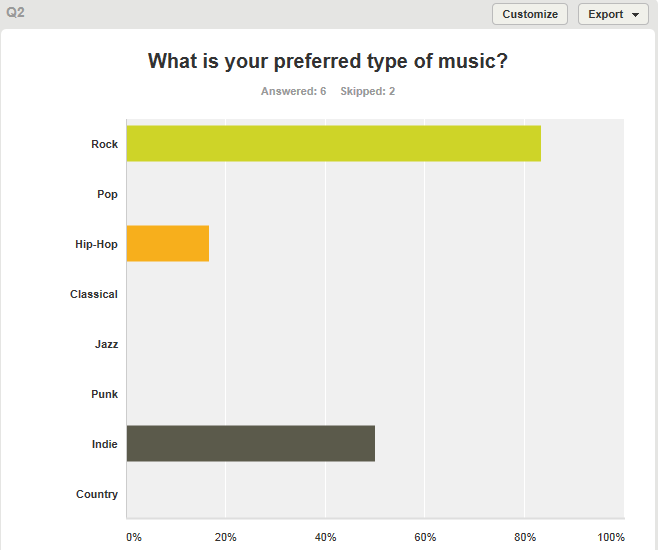
When asked what their favourite music was, most of my audience said rock, followed by indie, which works well as it is what my target genres are.

I asked my audience what the price of my magazine will be, and they said something between £2.00 and £2.99, which is what I was aiming for.

This question demonstrates a variety of answers, showing that the audience like to see reviews, interviews, tour dates etc.
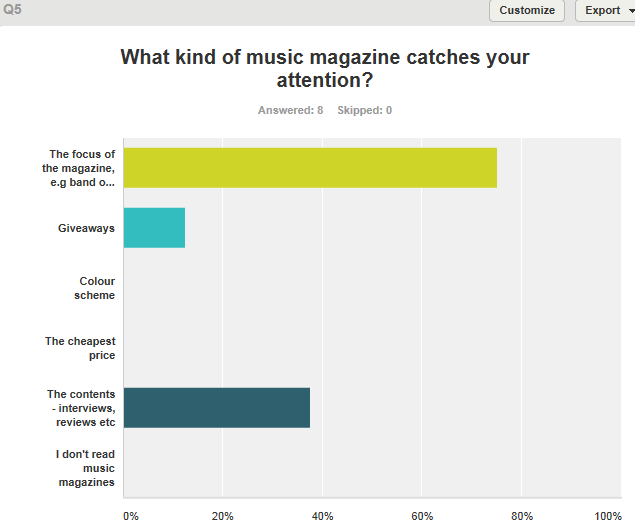
This question demonstrates that the eye-catching aspects of a magazine that grab the audiences attention are whats inside, and the focus of the magazine.

The audience said how the most important aspects are whats inside and whats on the cover, as oppose to giveaways.

This question showed various answers which I will take into consideration - however most popular being upcoming bands, which is what I was going to focus on anyway.
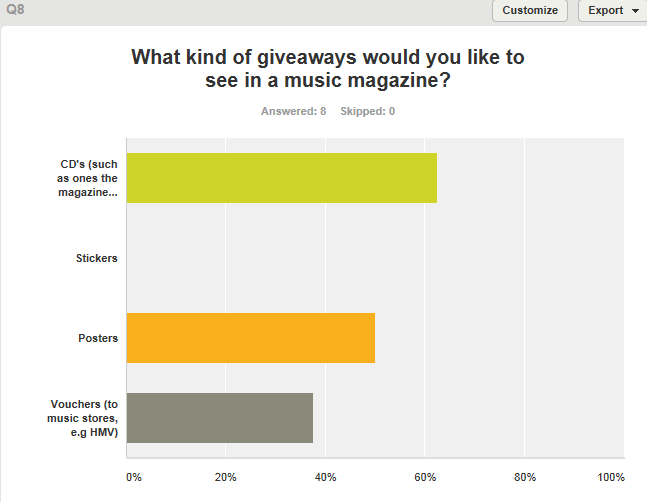
The type of giveaways people would like to see are CDs made by the magazine and posters, and I intended to use posters.
FLATPLANS

By using Photoshop, I created flatplans for my front cover, contents page and double page spread. The image above demonstrates what I aim my front cover to look like. The masthead would be across the top of the publication, so that it is clear and straightforward. I don't want my front cover to be overcrowded, so I will apply my coverlines to the sides of the magazine, in a smaller font than the masthead, but still large enough to read and notice. The main image will cover most of the magazine cover, I may cut around it so it has no background, however depending on how it looks, I may keep the background and use it as the full front cover background. I would like my image to be black and white, however I will have to see what this looks like first; it may change. Essential information will be placed in the bottom right hand corner (such as the barcode/date/etc), as this is where this is usually found.

This is a flatplan of my contents page. I will have the masthead at the top of the page, followed by the list of pages below it. I will make sure to add page numbers and have an expected amount of pages (e.g, 80-100, rather than just 20-30). There will be a main image on the left hand side which the text may help align - for example, the first page may go up to the models head, and then stop, and then the same with the shoulders, etc - giving almost an outline. The main image would have a quote going across it from the model/singer and across the bottom of the magazine there will be options to subscribe/get weekly issues, although this may change to something more interesting/different like an Editor's letter, depending on how it looks.

This flatplan demonstrates my double page spread interview with the focused artist. Across the top of the pages, there will be a pull quote taken from the interview which will be used as the masthead - to intruige the reader but to also make the reader aware that it is a double page spread. I will have 3 columns of text, although may add another image later depending on how it looks (if there's too much text, for instance) and the font will be readable however quite small as I will take into consideration the age group of the magazines audience.
DOUBLE PAGE SPREAD DECONSTRUCTION 3


In my opinion, this is the most effective double page spread out of the 3 I have analysed. This is due to the major conventions used, but also how the magazine publication, Rocksound, have put an individual mark on the interview - specifically with the main image. The interview is focused around the lead singer from the band Don Broco, and there is a smaller image of him at the top of the interview, beside the masthead, however the second page and the high key colour scheme grabs the readers attention. Rocksound have created a graphic image of the singer and with reflecting the image with a quote, turned him into 'Wolverine'. Quote: ("I often fantasise about being Wolverine"). The quote and image are quite comical and fun, and make the interview much more interesting and engaging.
The interview is displayed throughout 3 columns, and unexpectedly talks about his love for superheroes and comics, as oppose to his band. This reinforces the main image but also may attract a larger audience - for instance, fans of the band would read this, but because it is not centred around their music, readers who aren't fans of the band may be interested nonetheless.
The interview is layed out clear and it is easy to follow. The colour scheme is brightly coloured, mostly red, white and yellow, but some blue in the main image. The red and white contrast eachother and the yellow can be used to attract attention or highlight specific parts. The red text is the question asked by the interviewer, and the black text (which also contrasts to red/white/yellow) is the singers answer. Some of his answers are highlighted in yellow, this may be simply to add another contrasting colour but it may be used to highlight certain questions. The only aspect of the interview that focuses on the band as a whole is in the bottom right corner, which tells us that Don Broco's new single "Do I wanna know" is out now, as well as information about gig tickets.
The strapline is used to sum up the interview and give a brief overview, so this one talks about superheroes and how his life isn't just "black and white" - engaging the reader and again, making the interview sound much more interesting and less monotonous than the typical band interview about gigs and new singles.
I think this is the most successful double page spread due to the contrasting colours and how it isn't typical and boring. It interests the reader as it is giving another side to the singer - talking more about hobbies and interests than music. Although if it was an interview with the whole band, it is likely that it would be based around music and albums etc.
DOUBLE PAGE SPREAD DECONSTRUCTION 2


This double page spread has graphology which demonstrates a main image, strap line, text colomn and masthead. The main image is spread across the two pages and displays a photograph of the band, Mallory Knox.
Unlike other double page spread interviews, this one does not start with a dropcap. Instead, it uses subtitles or subheadings to almost catergorise the aspects of the interview; this may make it easier for the reader as the columns are summed up. The colour scheme is varied, as it has a fading effect. For instance, the masthead fades from red to yellow, and the background fades from dark into green. This connotes a new, fresh effect which reflects this new and upcoming band. The colour red is repeated again for the subheading, to highlight part of the strapline, but also through the clothing worn by 2 of the band members.
The text varies from white to black, depening on the colour of the background, so that the reader can still make out what it says. For instance, the strapline in white is against a dark colour whereas the black text of the interview is against a lighter green background. If these colours were swapped, the text would be unclear and difficult to read.
The main image is spread across both pages, so that the image can be enlarged but also so it dominates the page. The camera angle is tilted slightly upwards, to portray power over the new band - possible potential, for example - and to show clearly who the band are.
The first column of the interview includes a rhetorical question - immediately engaging the reader and making them think, as if involving them. Similarly, the strapline makes the reader want to continue finding out about this band due to the enthusiasm about the way they've played "mainstage" at festivals and have sold "thousands" of albums. Furthermore, Rocksound mention how this is their first cover feature interview with Mallory Knox, which may make fans of the band purchase the publication and attract more readers. It may also make current readers find interest in the band, as they are a similar genre to the focus of the magazine. The strapline pretty much sums up 2013 for Mallory Knox, letting fans and readers of the magazine have an insight as to their success and progress and what they may achieve throughout the next year.
Subscribe to:
Posts (Atom)